03/10/2026 | News
As part of the commemoration of the Cervera Millennium and the Isagoge cultural week, the Campaners de Cervera opened the doors of the bell tower of Santa Maria to the little ones with a workshop dedicated to discovering the manual ringing of bells.
During the activity, the boys and girls became bell ringers for a while: they knew the temple bells, they are going to stretch the cords, they operated the pedals and learned how to make them sound manually.
Bringing this heritage closer to new generations is one of the organization's goals. Xavier John, member of the Campaners de Cervera, explains that "we try to spread what the bells are, the bells and bells. And one of the pillars on which we base ourselves is to make it known to children so that they can learn it".
The workshop also served to explain the role that bells had traditionally played as a means of communication. “It was the way, before, people found out what was happening in the cities, as it was done and as we continue to do it here, to Cervera”, Xavier pointed out.
Beyond disseminating this heritage, the organization seeks to arouse the interest of future bell ringers and guarantee their replacement. "If in each course there is only one person left to be able to ring the bells and that he likes it, we consider ourselves satisfied", will affirm.
The workshop was free and continued the dissemination activities of this Cervera tradition.
02/10/2026 | News
The Feast of Saint Christ 2026 has offered four days of celebrations, of the 25 al 28 September, that have combined tradition, popular culture, music, sport and family activities. This edition was held in a particularly significant context, coinciding with the commemoration of Cervera's Millennium.
The recovery of the marquee, installed in the Place de Magdalena de Montclar, it has been shown to be a success, which has allowed the festive activity to be concentrated in the center of the city, which has favored participation and coexistence between diverse audiences.
The party opened with the proclamation of the Cervera cultural activist Carme Bonet Trilla. He affirmed that "it is a privilege to be the herald in the year of Cervera's Millennium, a city that I love and of which I feel proud". He was remembered by illustrious beer drinkers such as Josep Benet, M. Teresa Salat and Rosa Fabregat; he showed longing for the city of his childhood; lamented the disappearance, over time, of local cultural institutions; claimed the Catalan identity, and he praised urban transformations in recent years in the center of the city.
You can read the proclamation full in this link.
The organization honored this year was the Associació del Casal Cívic de Cervera, on the occasion of his 18th birthday, in an act of recognition in the Plenary Hall of the Paeria.
The chief paer, Jan Pomés, delivered the gift to Concepcion Caus, representative of the Board, who thanked the recognition and affirmed, others, that "being young is a gift, but so is growing up; have fun!”.
This act can be viewed at YouTube channel of the Paeria de Cervera.
Friday 25 it was also possible to enjoy a sardana audition and dance, with the prestigious Cobla The Main one of the Bisbal, that filled the Plaza Mayor; and the concert of the group Her Majesty and the performances of DJs Jose Lorenzo and Joe Lee, in the marquee.
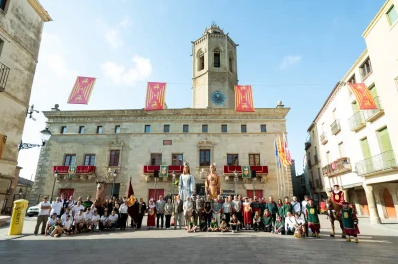
On Saturday 26 the streets of Cervera were filled with festivities with the 43rd Meeting of giant gangs and grallers. They participated 12 gangs, with the Cervera Giants as hosts; the Bombollers de Cervera percussion group and the deer Tibau.
As a novelty, after a years absence, the new giants of Cervera, Nasa Tobacco and Roger Fonollar, they went out again and celebrated the 35 years (1991-2026). And Roger debuted a new suit, made by Cervera fashion designer Gemma Oriol.
And in the marquee, the activity did not stop with musical performances for all audiences. One of the novelties has been the vermouth time concert, a proposal to swing dance to the rhythm of Noel Fortune Swing Out Band. In the evening it hosted the Cervera Sound youth music show, a concert to discover local talent in which Arkaitz and 3dgar performed, Joel Fígols, DJ Vexo i Tata, and the dance of the Elite Dance school. in the morning, the performances were carried out by Lasta Sanco, group from Cervera that fuses Latin and tribal rhythms combined with electronic music; the band of versions Band-Idos, i el popular DJ K-ZU.
The Sunday of Festa Major once again had popular and traditional culture as the main protagonist, with the entourage, in which the macers and bearers of the Senyera this year have been the Association of the Civic Center of Cervera, and the displays of festive elements in the Main Square.
The 65th Competition of sardanas, in which the local gangs, Jovencells and Tomorrow Jovencells, they were in first position in their respective categories.
The Municipal Corporation participated in the traditional going to office and the awarding of prizes to the sardanist gangs.
in squares and streets of the city of Cervera, the Castellera day with the Margeners of Guissona and the Castellers of Sabadell; the family show with the actor Pere Hosta; and the concert and dance with the Saturno Orchestra also filled the city center with a great festive atmosphere.
And on Monday 28 in September the Small Festival was held, a fully consolidated event, this year has reached its 16th edition, in which the children are the protagonists.
Tablada, parade and displays of festive elements, and the children's spoken word dance had the participation of schools and associations of students' families, La Caserna Theater Space, the Bombollers Youth Group and the Giants of Cervera, and the Joventuts and the Children's Group of the Cervera Carranquers Devil's Ball.
A fun and very participatory day that brings the popular and traditional culture of Cervera to all the children.
Besides, the rest of the activities were also experienced with a great participation of the public, that filled the marquee in the cantada of havaneras by Sons del Mediterrani and the concert by Popurris Trio, and enjoyed the theater with the representation of "Guilty Pleasure" and the fireworks display at the end of the Festa Major del Sant Crist 2026.
The Paeria de Cervera makes a very positive assessment of the Major Festival, especially in terms of diversity and participation in scheduled activities, and the involvement of local entities.
This year's edition had, Besides, the added value of being part of the Cervera Millennium commemoration, which allows the story to be highlighted, the heritage and culture of the city throughout the year.
Finally, the Paeria would like to thank the involvement of all entities, municipal services, Local Police and people who have contributed to the development of the Festa Major, as well as the participation of citizens in the various events.
02/10/2026 | News
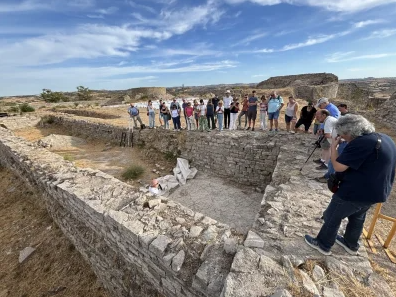
Cervera Castle hosted, Thursday 24 September, an outreach day, framed within the acts of the Isagoge, which combined a guided visit to the site with the presentation of the preliminary results of the archaeological intervention of 2026.
The first part of the day will consist of a guided tour of the castle. Initially provided in a single shift, Due to the high demand for reservations, two visits were scheduled, them 17.30 hi to them 18 hours, which brought together approximately one hundred attendees.
During the tour, the participants learned about the geographical and historical context of the castle, the structure of this year's archaeological intervention and they were able to see the area where the ichnites have been located, the fossilized footprints of prehistoric animals discovered during this summer's campaign.
The Municipal Auditorium hosted the second part, which was the presentation of the preliminary results of the intervention, by several members of the archeology research team of La Nova de Cervera. The session placed the action within the research project "Population dynamics in the Vall de l'Ondara: from protohistory to the Middle Ages" and presented the first results of a campaign developed with the support of two youth work camps. Besides, some of the digitization works of the archaeological and paleontological heritage that have been developed within the project were also shown.
The main objective of the intervention was to find out the state of conservation of the areas of the castle that had been excavated nearly twenty years ago, essential information to guide the future phases of research and conservation of this heritage space.
02/10/2026 | News
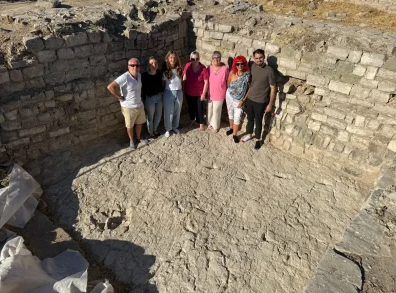
An excavation to delve deeper into the medieval past of Cervera Castle has ended up opening a window to a much more remote past. This summer's archaeological work has brought to light a trail of fossilized footprints 30 millions of years old, corresponding to the Oligocene period. An exceptional discovery that allows us to go back millions of years in the history of this place.
The discovery was made as part of the research project "Population dynamics in the Ondara valley: from Protohistory to the Middle Ages", promoted by the archaeological research group of the Associació La Nova de Cervera and selected in the call for Quadrennial Archeology Projects of the Generalitat de Catalunya.
The main researcher of the project, the archaeologist Sabina Vall, explains that this year's campaign was planned to intervene again in spaces excavated at the beginning of the year 2000 and check the state of the deposit, especially in the northern sector of the castle. There was nothing to predict that the work would end up revealing a paleontological trace.
"During the intervention in one of the areas where we were working, a trace of fossilized footprints appeared to us that we did not expect. It was a great find, exceptional, especially because of the state of conservation they are in", points out Vall. The researcher points out that the footprints have survived to this day despite being in a walled and fortified area that has undergone numerous transformations over the centuries.
The discovery, adds, "gives added value to the project", because it expands an initially archaeological research into the field of paleontology.
An animal related to horses
The paleontologist and director of the Museum of the Basin Beyond Isona, Angel Galobart, places the footprints approx 30 millions of years. "They have found the trace of some animal that stepped on this area some thirty million years ago. It's funny because you see all the constructions and, all of me, there is a very well-defined trail", explains.
The identification of the animal is still preliminary, but the first studies indicate that the footprints could correspond to a paleotherid, an extinct mammal
related to horses. It would be a herbivorous animal smaller than a current horse and which could have three fingers on its limbs.
The footprints, of among 10 i 15 centimeters, they have already been identified as fossilized footprints and will now be the subject of a more in-depth study. The researchers have carried out photogrammetry of the surface and generated a three-dimensional model of the track, which will make it possible to analyze their morphology in detail and make progress in identifying the animal that left them.
The find is also interesting for its location. According to the specialists, until now there was no evidence of a trace of these characteristics so far south of this area, a fact that can provide new data on the Oligocene fauna and landscape in La Segarra and expand the paleontological study area.
From archeology to paleontology
From the Paeria de Cervera, the paer in head, Jan Pomés, has celebrated a discovery that reinforces the commitment to recover and study local heritage. "We are very happy about this find, because we embarked on a new path in the archaeological field. It was many years ago, archaeologically, he did not look towards the castle and, in general, nor had this area been worked on much in Cervera", states.
Pomés values the continuity of research and collaboration between professionals, institutions and administrations to deepen the knowledge of Cervera's past.
For his part, Montserrat Parra, director of the Territorial Services of the Department of Culture of the Government of Catalonia in Lleida, highlights that action was taken immediately after the discovery. "As soon as the footprints were found, we contacted the Archeology Service of the Territorial Services. We came to see it with the paleontologists and we found that they really were footprints with possibilities and that it was necessary to study and analyze them", explains.
Later, Reports must be requested from organizations specializing in paleontology to determine the supply and relevance of the discovery.. According to Parra, the first results are "really encouraging" and open up a new field of study to delve into the most remote past of the territory.
Cervera looks further back than ever
The discovery comes in a particularly symbolic year for the city. Cervera commemorates this year the thousand years of the settlement charter, but the footprints found in the castle now force us to look much further back.
"We bet a lot on archaeology. Everything that has been worked on from a more historical point of view is very good, but there is also prehistory, that which goes beyond the moment when the documents disappear and nothing remains but the stones", the pair stands out in cap.
Like this, while Cervera celebrates a thousand years of documented history, the castle has unexpectedly revealed a testimony of an immensely more distant past: the footsteps of an animal that walked through this place a few years ago 30 millions of years.
02/10/2026 | News
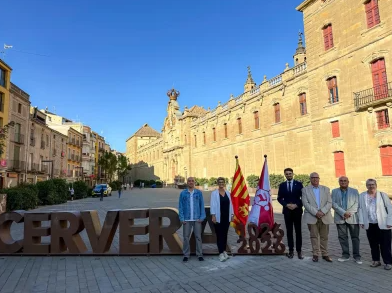
Friday 18 September, coinciding with the beginning of the Isagoge, the new Cervera Millennium commemorative plaque was inaugurated in Plaça de la Universitat.
The action consisted of installing the numbers 1026 i 2026, an intervention that symbolizes the thousand years that have passed since the granting of the Settlement Charter and that contributes to reinforcing the image of the Millennium commemoration.
The initiative arose as a proposal presented by the Cerverí Heritage Interpreters Association, from the idea of Armand Forcat, in the framework of the Millennium events, and has had the support of the Paeria de Cervera Tourism Board.
The act of presenting the sign was opened by the Councilor for Tourism, Judith Guim, that stood out “the importance of continuing to promote actions that contribute to enhancing the city's heritage and history”. Right after, a representative of the Cerverí Heritage Interpreters Association explained the origin of the proposal and its fit within the commemorative events of the Millennium. The inauguration concluded with the intervention of the father in chief, Jan Pomés, what “thanked the involvement of the entities and all the people who make possible the celebration of the thousand years of the city's history”.
Cervera's letters, located in the University Square, have established themselves as one of the most photographed spaces in the city. Its privileged situation, with the University of Cervera in the background, turns this place into a point of reference both for visitors and for beer drinkers themselves when it comes to immortalizing their passage through the city.
The new signage has been very well received from the start and has attracted the interest of many people, who have already incorporated it into their photographs. This way, the space is reinforced as one of the main iconic points of the municipality and as another element of the celebration of Cervera's thousand years of history.
10/09/2026 | News
9 of September of 2026
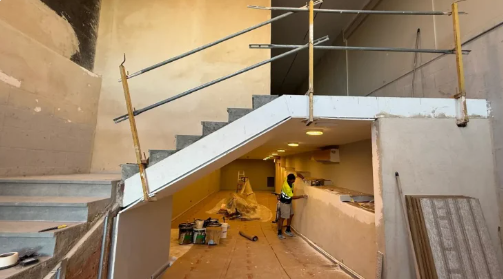
The Museu de Cervera enters the final stretch of the second phase of the rehabilitation of the first floor, an action that has renovated the temporary exhibition hall to make it more accessible and functional and facilitate the reception of new traveling exhibits. The works have made it possible to eliminate the slope that the floor presented and to renovate the facilities to guarantee accessibility to the different spaces. Almost a year of execution, the work is expected to end in the coming weeks.
This second phase had a budget of 362.000 euros, financed mostly with contributions from the Generalitat de Catalunya, the Diputació of Lleida and the Paeria of Cervera. The action continues a first phase in which the museum lobby was renovated, the reception, the lighting and the space of the store, in addition to renewing the image of the equipment. All of the interventions aim to improve the experience of visitors and move towards a Museum that is more accessible and adapted to current needs.
The rehabilitation is part of a wider transformation project for the Cervera Museum. The chief paer, Jan Pomés, explains that "we understand the Cervera Museum as a large umbrella that integrates the Marc Márquez space, temporary exhibitions, the archaeological heritage, popular culture and the Wheat Museum, among new spaces we are preparing. We want it to be the benchmark for explaining and researching our culture, our identity and our history. The House Museum will continue to be essential, but as another piece within a more diverse and expanded museum project". This new concept should also allow more visibility to Cervera's archaeological heritage.
Beyond the strictly museum activity, this transformation contributes to revitalizing this heritage axis of the historic center and to strengthening the link between the facility and the public.